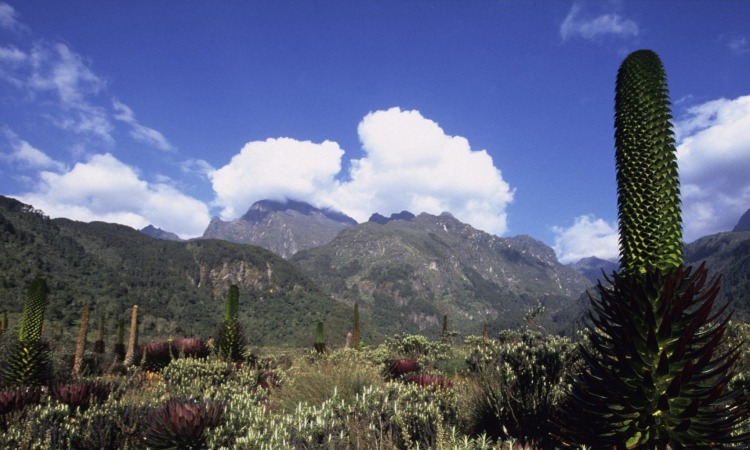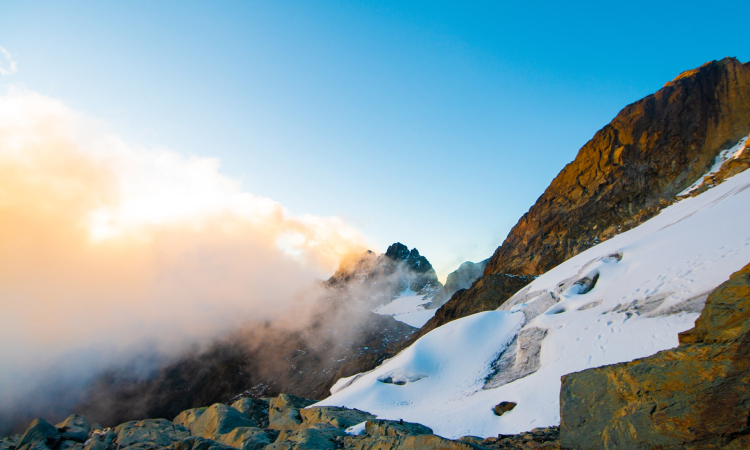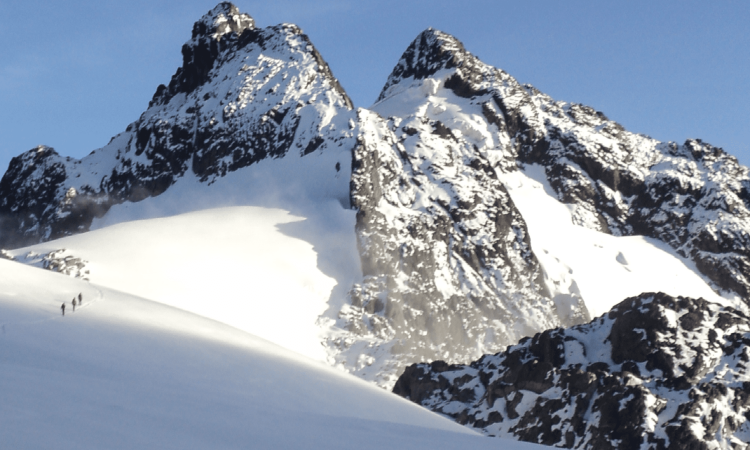

Margherita Peak is Africa’s third highest peak, but the real adventure is in the climb along the Kilembe route. The forests and valleys are rich with trees, ferns, and many plant species. The trees are home to birds and primates, and along the trail you may see chimp nests high in the branches. With luck, you may spot chimpanzees moving away quickly.
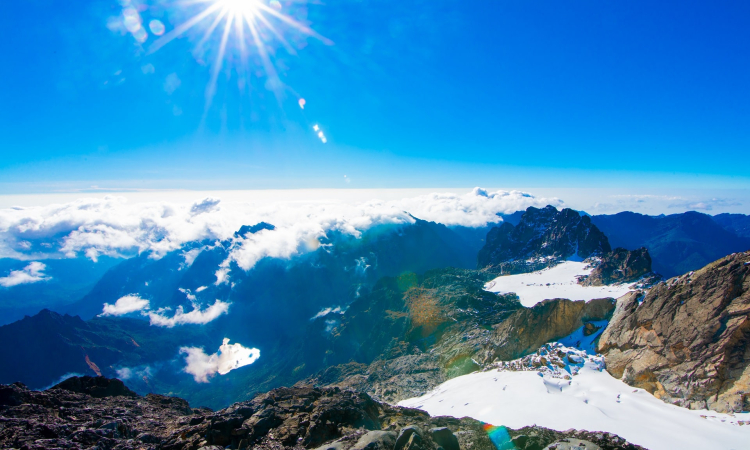
Climbing Margherita Peak is more of a hard scramble than a technical climb, except for a few steep moves. When it snows, it becomes more difficult, but the reward of standing at the top is worth it. From the summit, you can see Albert Peak, the Congo side, and wide views of the Rwenzori Mountains.
We provide all the climbing equipment, such as crampons, ropes, harnesses, carabiners, helmets, ice axes, ice screws, and ascenders. You need to bring good hiking boots, warm clothes, a warm sleeping bag, and rain gear.
Note: Climbing Margherita Peak is now technical. It is important to know how to use ropes, crampons, ascenders, figure-8s for belaying, and ice axes. Some ice sections are as steep as 60% and are changing quickly due to climate change and the melting glacier.
All our guides are trained in ice climbing and rescue. Even if you have little experience, they can guide you, but you should be ready to learn on the way. You must know how to fit crampons, tie basic knots, and use an ascender and figure-8. Mt Baker and Mt Speke are also technical. We advise bringing your own crampons, as the mix of ice and rocks wears them down quickly.
8-Day Rwenzori Trekking Tour Highlights
- Day 1: Hike to Sine Camp (2,596m)
- Day 2: Hike to Mutinda Camp (3,588m)
- Day 3: Hike to Bugata Camp (4,100m)
- Day 4: Hike to Hunwick’s Camp (3,974m)
- Day 5: Hike to Margherita Camp (4,485m)
- Day 6: Summit Margherita Peak (5,109m)
- Day 7: Descend to Kiharo Camp (3,640m)
- Day 8: Descend to Basecamp (1,450m)
Detailed 8-Day Rwenzori Trekking Tour Itinerary
Day 1: Hike to Sine Camp (2,596m)
Start at Trekkers Hostel (1,450m) and hike to Sine Hut (2,596m), gaining 1,146m. Fit hikers may continue to Kalalama Camp (3,134m) for more time later at Mutinda Camp and Mutinda Lookout (3,975m).
The trail follows the valley floor through tall Afro-Montane forest. You may see blue monkeys, black-and-white colobus in groups, and sometimes the rare L’Hoest monkey. You might also hear chimpanzees in the distance. The forest is full of bamboo, shrubs, flowers, moss, fungi, and vines hanging from the trees.
Enock’s Falls, only 200m from Sine Hut, is a great place for photos. Sine Camp has wooden huts on a ridge among tall trees, with views of a waterfall far below. Visitors often relax outside by the campfire.
Day 2: Hike to Mutinda Camp (3,588m)
The trek begins at 8:30am. Soon you enter the bamboo zone, which is steep and slippery in the wet season. After climbing 551m over 1.8km, you reach Kalalama Camp (3,147m), where you can rest before heading on.
The trail crosses streams and mossy waterfalls, then follows a river under giant heather trees covered with moss and lichen. The valley is often misty, with many flowers and plants.
In the afternoon, you can climb Mutinda Lookout (3,975m). From here, you see the Rwenzori Mountains, Kasese town, and Lake George. This climb also helps with acclimatization.
Sleep at Mutinda Camp.
Day 3: Hike to Bugata Camp (4,100m)
The trail is boggy, especially in the wet season, but boardwalks help. You cross Mutinda Valley with tussock grass, everlasting flowers, and giant lobelias before climbing steeply into Namusangi Valley (3,840m). The valley has waterfalls and views of Mutinda Peaks. From there, you continue up and down until you reach Bugata Camp (4,100m).
Day 4: Hike to Hunwick’s Camp (3,974m)
From Bugata, climb a ridge, descend slightly, then continue to Bamwanjarra Pass (4,450m). On clear days, you see all three main peaks. The trail goes through bogs, moss, groundsel, and lobelia, where malachite sunbirds are often seen. After some steep sections, you arrive at Hunwick’s Camp, set on a ridge with views of Mt Stanley, Mt Baker, Weismann’s Peak, and McConnell’s Prong.
Day 5: Hike to Margherita Camp (4,485m)
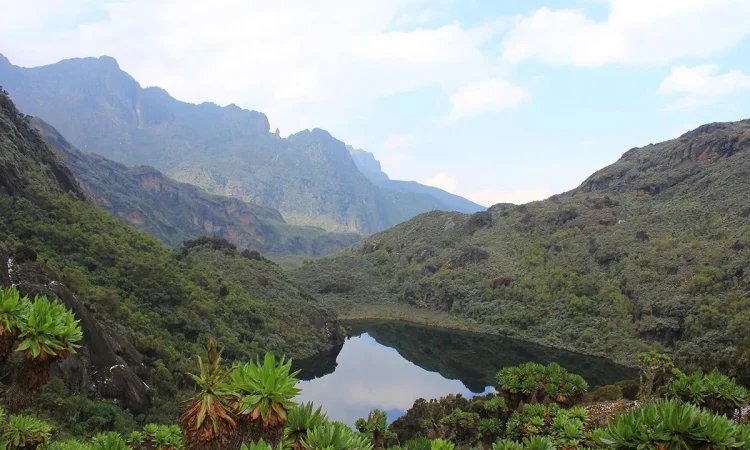
From Hunwick’s, descend across the valley floor to Lake Kitandara, with its deep waters and thick vegetation. From here, climb Scott Elliott Pass to Margherita Camp (4,485m), set among large rocks for shelter from the wind. This is where the Duke of Abruzzi camped in 1906 before his summit climb.
Day 6: Summit Margherita Peak (5,109m)
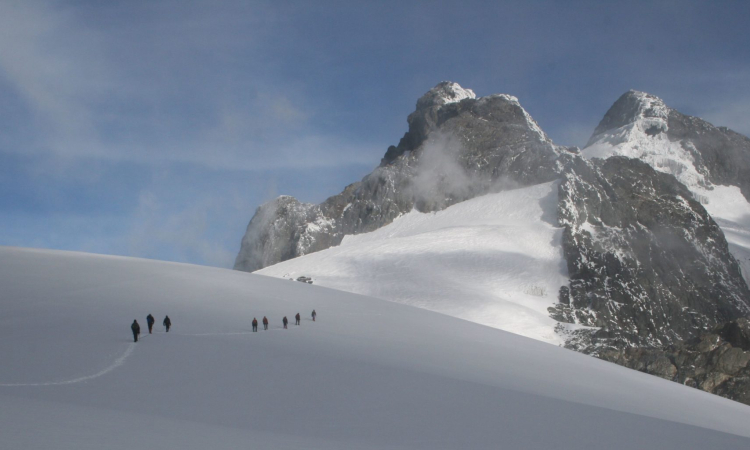
Wake at 2:00am for an early breakfast, then start the climb at 2:30am. Early starts are important, as clouds and snow often close in by early afternoon. In January and February 2017, climbers faced heavy snowstorms even in the dry season, some returning late at night completely exhausted.
Because of these conditions, there is a strict turnaround time of 10:00am. If you do not reach the peak by then, you must descend for safety. The glacier has become steeper, with sections of more than 60% incline. Melting ice has created caves underneath, which can collapse, so you must follow the guides’ instructions carefully.
For less experienced climbers, there is the option to stay on Stanley Glacier and climb a rocky outcrop near Alexandra Peak for wide views of Congo and the mountain ridges.
After summiting, descend to Hunwick’s Camp (3,874m).
Day 7: Descend to Kiharo Camp (3,640m)
Distance: 11km. Time: 4–7 hours.
From Hunwick’s, climb a ridge to McConnell’s Prong for views of all three peaks. Cross Oliver’s Pass (4,505m), then follow the trail below Weismann’s Peak to the Nyamwamba River.
From here, you may climb Weismann’s Peak (4,620m) at extra cost. On clear days, you see Margherita, Mt Stanley, Mt Speke, and Mt Baker.
Continue down the valley to Kiharo Camp, set in a deep valley with high cliffs and thick vegetation. On the way, you pass ridges left behind by ancient glaciers.
Day 8: Descend to Basecamp (1,450m)
Distance: 12.2km to the park gate, plus 2.8km to Trekkers Hostel. Time: 5–8 hours. Start early if you need to catch a flight or travel on.
The Nyamwamba Valley descent is mostly downhill, with waterfalls, moss-covered rocks, rivers, and forests. It is one of the most rewarding trails in the Rwenzoris. This path took six years to open. In 1937, explorer McConnell attempted it but failed. Today, trekkers can enjoy the valley he could not pass.
A few kilometers from Kiharo Camp, the path follows the river. You may see duikers feeding in open areas. Sometimes the route follows the river itself, hopping across rocks. Lower down, the river becomes too steep, with many waterfalls, so the trail moves to a ridge to bypass. Later, you return to the river at a rock shelter, where you can rest. After crossing a small stream, climb a gentle slope, then return to the river again to avoid more impassable waterfalls.
The forest here is alive with birds, primates, duikers, and hyrax. It makes a wonderful ending to the trek.